Jumat, 31 Desember 2010

[X123.Ebook] Download Ebook Lock-In Amplifiers: Principles and Applications (IEE electrical measurement series), by M. L. Meade

Download Ebook Lock-In Amplifiers: Principles and Applications (IEE electrical measurement series), by M. L. Meade

From the mix of expertise and also activities, someone could enhance their skill and capacity. It will certainly lead them to live and work much better. This is why, the pupils, employees, or even companies ought to have reading behavior for books. Any book Lock-In Amplifiers: Principles And Applications (IEE Electrical Measurement Series), By M. L. Meade will offer certain expertise to take all benefits. This is what this Lock-In Amplifiers: Principles And Applications (IEE Electrical Measurement Series), By M. L. Meade tells you. It will certainly include more expertise of you to life as well as function far better. Lock-In Amplifiers: Principles And Applications (IEE Electrical Measurement Series), By M. L. Meade, Try it as well as prove it.

Lock-In Amplifiers: Principles and Applications (IEE electrical measurement series), by M. L. Meade

Lock-In Amplifiers: Principles and Applications (IEE electrical measurement series), by M. L. Meade


Lock-In Amplifiers: Principles and Applications (IEE electrical measurement series), by M. L. Meade

Download Ebook Lock-In Amplifiers: Principles and Applications (IEE electrical measurement series), by M. L. Meade

Lock-In Amplifiers: Principles And Applications (IEE Electrical Measurement Series), By M. L. Meade. Exactly what are you doing when having downtime? Talking or searching? Why don't you try to check out some book? Why should be checking out? Reviewing is one of enjoyable and pleasurable task to do in your extra time. By checking out from numerous resources, you could find new information as well as encounter. Guides Lock-In Amplifiers: Principles And Applications (IEE Electrical Measurement Series), By M. L. Meade to review will certainly many beginning with clinical publications to the fiction publications. It suggests that you can check out the publications based on the requirement that you intend to take. Certainly, it will be various and you could check out all publication types whenever. As below, we will reveal you an e-book must be read. This e-book Lock-In Amplifiers: Principles And Applications (IEE Electrical Measurement Series), By M. L. Meade is the option.

Yet, what's your matter not too liked reading Lock-In Amplifiers: Principles And Applications (IEE Electrical Measurement Series), By M. L. Meade It is a fantastic activity that will certainly always offer wonderful benefits. Why you become so weird of it? Several points can be practical why individuals do not want to review Lock-In Amplifiers: Principles And Applications (IEE Electrical Measurement Series), By M. L. Meade It can be the monotonous activities, the book Lock-In Amplifiers: Principles And Applications (IEE Electrical Measurement Series), By M. L. Meade compilations to read, even careless to bring nooks everywhere. Now, for this Lock-In Amplifiers: Principles And Applications (IEE Electrical Measurement Series), By M. L. Meade, you will certainly begin to love reading. Why? Do you understand why? Read this web page by finished.

Starting from visiting this site, you have aimed to start nurturing reading a book Lock-In Amplifiers: Principles And Applications (IEE Electrical Measurement Series), By M. L. Meade This is specialized website that market hundreds compilations of books Lock-In Amplifiers: Principles And Applications (IEE Electrical Measurement Series), By M. L. Meade from great deals resources. So, you won't be burnt out anymore to select guide. Besides, if you likewise have no time to search guide Lock-In Amplifiers: Principles And Applications (IEE Electrical Measurement Series), By M. L. Meade, simply rest when you're in office as well as open the browser. You can discover this Lock-In Amplifiers: Principles And Applications (IEE Electrical Measurement Series), By M. L. Meade inn this web site by attaching to the net.

Get the link to download this Lock-In Amplifiers: Principles And Applications (IEE Electrical Measurement Series), By M. L. Meade and also start downloading and install. You can really want the download soft data of guide Lock-In Amplifiers: Principles And Applications (IEE Electrical Measurement Series), By M. L. Meade by undertaking various other activities. Which's all done. Currently, your rely on read a publication is not constantly taking and carrying the book Lock-In Amplifiers: Principles And Applications (IEE Electrical Measurement Series), By M. L. Meade almost everywhere you go. You can save the soft data in your gizmo that will never ever be far away as well as review it as you like. It is like checking out story tale from your gadget after that. Currently, start to like reading Lock-In Amplifiers: Principles And Applications (IEE Electrical Measurement Series), By M. L. Meade and also get your brand-new life!

Lock-In Amplifiers: Principles and Applications (IEE electrical measurement series), by M. L. Meade

Part of a series this book deals with the principles of phase-sensitive detection and with the specification and handling characteristics of modern lock-in amplifiers. Among the topics included are applications for two-phase lock-in amplifiers, the problems of phase-locking to very noisy signals, a review of system configurations for heterodyne and PWM lock-in amplifiers and the use of lock-in amplifiers in computer-controlled measurements. The material is presented at systems level throughout and covers many practical aspects of signal recovery in research applications.

  • Sales Rank: #4614435 in Books
  • Published on: 1983-07
  • Original language: English
  • Number of items: 1
  • Binding: Paperback
  • 248 pages

Most helpful customer reviews

See all customer reviews...

Lock-In Amplifiers: Principles and Applications (IEE electrical measurement series), by M. L. Meade PDF
Lock-In Amplifiers: Principles and Applications (IEE electrical measurement series), by M. L. Meade EPub
Lock-In Amplifiers: Principles and Applications (IEE electrical measurement series), by M. L. Meade Doc
Lock-In Amplifiers: Principles and Applications (IEE electrical measurement series), by M. L. Meade iBooks
Lock-In Amplifiers: Principles and Applications (IEE electrical measurement series), by M. L. Meade rtf
Lock-In Amplifiers: Principles and Applications (IEE electrical measurement series), by M. L. Meade Mobipocket
Lock-In Amplifiers: Principles and Applications (IEE electrical measurement series), by M. L. Meade Kindle

Lock-In Amplifiers: Principles and Applications (IEE electrical measurement series), by M. L. Meade PDF

Lock-In Amplifiers: Principles and Applications (IEE electrical measurement series), by M. L. Meade PDF

Lock-In Amplifiers: Principles and Applications (IEE electrical measurement series), by M. L. Meade PDF

Rabu, 29 Desember 2010

[W106.Ebook] Download Ebook ToshiƩ: A Story of Village Life in Twentieth-Century Japan, by Simon Partner

Download Ebook ToshiƩ: A Story of Village Life in Twentieth-Century Japan, by Simon Partner

Recognizing the method the best ways to get this book ToshiƩ: A Story Of Village Life In Twentieth-Century Japan, By Simon Partner is additionally valuable. You have remained in ideal website to begin getting this details. Obtain the ToshiƩ: A Story Of Village Life In Twentieth-Century Japan, By Simon Partner web link that we provide right here and check out the web link. You can order guide ToshiƩ: A Story Of Village Life In Twentieth-Century Japan, By Simon Partner or get it as quickly as possible. You could promptly download this ToshiƩ: A Story Of Village Life In Twentieth-Century Japan, By Simon Partner after obtaining bargain. So, when you require guide swiftly, you could straight receive it. It's so very easy therefore fats, isn't it? You need to like to this way.

ToshiƩ: A Story of Village Life in Twentieth-Century Japan, by Simon Partner

ToshiƩ: A Story of Village Life in Twentieth-Century Japan, by Simon Partner


ToshiƩ: A Story of Village Life in Twentieth-Century Japan, by Simon Partner

Download Ebook ToshiƩ: A Story of Village Life in Twentieth-Century Japan, by Simon Partner

ToshiƩ: A Story Of Village Life In Twentieth-Century Japan, By Simon Partner. In what instance do you like checking out a lot? What about the kind of the e-book ToshiƩ: A Story Of Village Life In Twentieth-Century Japan, By Simon Partner The should review? Well, everyone has their own reason needs to review some e-books ToshiƩ: A Story Of Village Life In Twentieth-Century Japan, By Simon Partner Primarily, it will certainly relate to their requirement to obtain expertise from the e-book ToshiƩ: A Story Of Village Life In Twentieth-Century Japan, By Simon Partner as well as really want to read merely to obtain enjoyment. Books, tale e-book, and also other entertaining books end up being so popular this day. Besides, the scientific books will certainly also be the most effective need to decide on, specifically for the pupils, educators, physicians, business owner, as well as other careers who enjoy reading.

To conquer the issue, we now offer you the modern technology to obtain the book ToshiƩ: A Story Of Village Life In Twentieth-Century Japan, By Simon Partner not in a thick published data. Yeah, reviewing ToshiƩ: A Story Of Village Life In Twentieth-Century Japan, By Simon Partner by on-line or getting the soft-file only to check out can be among the ways to do. You could not really feel that reading a publication ToshiƩ: A Story Of Village Life In Twentieth-Century Japan, By Simon Partner will work for you. But, in some terms, May individuals effective are those which have reading practice, included this kind of this ToshiƩ: A Story Of Village Life In Twentieth-Century Japan, By Simon Partner

By soft data of guide ToshiƩ: A Story Of Village Life In Twentieth-Century Japan, By Simon Partner to review, you may not have to bring the thick prints all over you go. Any type of time you have going to review ToshiƩ: A Story Of Village Life In Twentieth-Century Japan, By Simon Partner, you could open your kitchen appliance to review this publication ToshiƩ: A Story Of Village Life In Twentieth-Century Japan, By Simon Partner in soft file system. So simple as well as rapid! Reviewing the soft documents publication ToshiƩ: A Story Of Village Life In Twentieth-Century Japan, By Simon Partner will offer you easy way to review. It can additionally be quicker because you can review your publication ToshiƩ: A Story Of Village Life In Twentieth-Century Japan, By Simon Partner almost everywhere you really want. This on-line ToshiƩ: A Story Of Village Life In Twentieth-Century Japan, By Simon Partner can be a referred book that you could enjoy the remedy of life.

Due to the fact that e-book ToshiƩ: A Story Of Village Life In Twentieth-Century Japan, By Simon Partner has excellent advantages to read, lots of people now expand to have reading routine. Supported by the developed technology, nowadays, it is not difficult to purchase the book ToshiƩ: A Story Of Village Life In Twentieth-Century Japan, By Simon Partner Even the publication is not existed yet in the market, you to hunt for in this website. As exactly what you can locate of this ToshiƩ: A Story Of Village Life In Twentieth-Century Japan, By Simon Partner It will actually alleviate you to be the first one reading this book ToshiƩ: A Story Of Village Life In Twentieth-Century Japan, By Simon Partner and obtain the advantages.

ToshiƩ: A Story of Village Life in Twentieth-Century Japan, by Simon Partner

Sakaue Toshi� was born on August 14, 1925, into a family of tenant farmers and day laborers in the hamlet of Kosugi. The world she entered was one of hard labor, poverty, dirt, disease, and frequent early death. By the 1970s, that rural world had changed almost beyond recognition. Toshi� is the story of that extraordinary transformation as witnessed and experienced by Toshi� herself. A sweeping social history of the Japanese countryside in its twentieth-century transition from "peasant" to "consumer" society, the book is also a richly textured account of the life of one village woman and her community caught up in the inexorable march of historical events.

Through the lens of Toshi�'s life, Simon Partner shows us the realities of rural Japanese life during the 1930s depression; daily existence under the wartime regime of "spiritual mobilization"; the land reform and its consequences during occupation; and the rapid emergence of a consumer culture against the background of agricultural mechanization during the 1950s and 1960s. In some ways representative and in other ways unique, Toshi�'s narrative raises questions about conventional frameworks of twentieth-century Japanese history, and about the place of individual agency and choice in an era often seen as dominated by the impersonal forces of modernity: technology, state power, and capitalism.

  • Sales Rank: #935849 in Books
  • Published on: 2004-03-25
  • Original language: English
  • Number of items: 1
  • Dimensions: 9.00" h x .50" w x 6.00" l, .67 pounds
  • Binding: Paperback
  • 210 pages

From the Inside Flap
"Within the lively and often gripping story of Sakaue Toshi� and her world, Partner gives us a sweeping and thought-provoking history of social change in rural Japan and sheds new light on key developments such as war mobilization and US occupation reforms. Fresh, personal, and engaging."—Steven Ericson, author of The Sound of the Whistle: Railroads and the State in Meiji Japan

"Partner beautifully tells the story of the life and times of a farm woman from the 1920s to the present. He traverses seamlessly between the often moving details of her life and the large transformations which it exemplifies."—Andrew Gordon, Harvard University

From the Back Cover
"Within the lively and often gripping story of Sakaue Toshie and her world, Partner gives us a sweeping and thought-provoking history of social change in rural Japan and sheds new light on key developments such as war mobilization and US occupation reforms. Fresh, personal, and engaging."--Steven Ericson, author of "The Sound of the Whistle: Railroads and the State in Meiji Japan

"Partner beautifully tells the story of the life and times of a farm woman from the 1920s to the present. He traverses seamlessly between the often moving details of her life and the large transformations which it exemplifies."--Andrew Gordon, Harvard University

About the Author
Simon Partner is Associate Professor of Japanese History at Duke University. He is the author of Assembled in Japan: Electrical Goods and the Making of the Japanese Consumer (California, 1999).

Most helpful customer reviews

7 of 7 people found the following review helpful.
A well-written history of rural life in 20th century Japan
By Bryan L
In his book "Toshie", Simon Partner provides a detailed account of village life throughout 20th century Japan. The historical and sociological information is carefully selected; each piece deepens the reader's understanding of the life of Toshie and her fellow villagers. Partner's observations on World War II, village life, and the rise of consumer culture in Japan are all welcome additions to the study of Japanese history. The real strength of the book, however, is Partner's vivid descriptions. From the beginning, one feels as if they are looking over the shoulder of the midwife during the birth of the protagonist, Toshie. These fine descriptions continue throughout the book and one can nearly breathe the fresh village air or sweat alongside the farmers and laborers as they toil into the night.
For anyone who is interested in Japanese history, village life, or simply looking for a good read, I highly reccomend this book.

9 of 10 people found the following review helpful.
Best Book on Village Life in Japan
By G. Doi
I thoroughly enjoyed reading the book. I am a third generation Japanese American(sansei) born and raised in Hawaii. My grandparents came here from Niigata ken, which is the setting of the book, around the turn of the 20th century. They came as laborers to work in the sugar plantations. Therefore I found the details about village life in Niigata very relevant to their experiences in America.
I have read many accouns of life in the Japanese countryside through the years ("Shinohata", "Village Japan", and "A Far Valley" come to mind). But Partner's book is the best I have read because of the combination of historical and sociological data. It is also filled with sensitivity to the lives of Toshie and others in her village.
I recently visited Niigata for the first time. Of course, spending two days there as a tourist did not give me as much of an in-depth look as I would have liked. But I will go back again, partly because Partner's work has increased my level of awareness.

1 of 1 people found the following review helpful.
Three Stars
By Judith H. Scott
More of a sociological study of a village in Japan...pre-war, during WWII and post-war.

See all 4 customer reviews...

ToshiƩ: A Story of Village Life in Twentieth-Century Japan, by Simon Partner PDF
ToshiƩ: A Story of Village Life in Twentieth-Century Japan, by Simon Partner EPub
ToshiƩ: A Story of Village Life in Twentieth-Century Japan, by Simon Partner Doc
ToshiƩ: A Story of Village Life in Twentieth-Century Japan, by Simon Partner iBooks
ToshiƩ: A Story of Village Life in Twentieth-Century Japan, by Simon Partner rtf
ToshiƩ: A Story of Village Life in Twentieth-Century Japan, by Simon Partner Mobipocket
ToshiƩ: A Story of Village Life in Twentieth-Century Japan, by Simon Partner Kindle

ToshiƩ: A Story of Village Life in Twentieth-Century Japan, by Simon Partner PDF

ToshiƩ: A Story of Village Life in Twentieth-Century Japan, by Simon Partner PDF

ToshiƩ: A Story of Village Life in Twentieth-Century Japan, by Simon Partner PDF

Selasa, 28 Desember 2010

[T669.Ebook] Free PDF Battlefield of the Mind: Winning The Battle in Your Mind - Study Guide, by Joyce Meyer

Free PDF Battlefield of the Mind: Winning The Battle in Your Mind - Study Guide, by Joyce Meyer

Yeah, reading a book Battlefield Of The Mind: Winning The Battle In Your Mind - Study Guide, By Joyce Meyer could add your buddies listings. This is among the solutions for you to be effective. As recognized, success does not indicate that you have terrific things. Understanding and also understanding even more compared to other will certainly offer each success. Beside, the notification as well as perception of this Battlefield Of The Mind: Winning The Battle In Your Mind - Study Guide, By Joyce Meyer can be taken and chosen to act.

Battlefield of the Mind: Winning The Battle in Your Mind - Study Guide, by Joyce Meyer

Battlefield of the Mind: Winning The Battle in Your Mind - Study Guide, by Joyce Meyer


Battlefield of the Mind: Winning The Battle in Your Mind - Study Guide, by Joyce Meyer

Free PDF Battlefield of the Mind: Winning The Battle in Your Mind - Study Guide, by Joyce Meyer

Exactly what do you do to start reviewing Battlefield Of The Mind: Winning The Battle In Your Mind - Study Guide, By Joyce Meyer Searching the publication that you love to check out initial or find an appealing book Battlefield Of The Mind: Winning The Battle In Your Mind - Study Guide, By Joyce Meyer that will make you intend to review? Everyone has difference with their factor of reading an e-book Battlefield Of The Mind: Winning The Battle In Your Mind - Study Guide, By Joyce Meyer Actuary, checking out practice needs to be from earlier. Many individuals might be love to review, yet not a book. It's not fault. A person will be bored to open the thick book with tiny words to check out. In more, this is the actual condition. So do occur probably with this Battlefield Of The Mind: Winning The Battle In Your Mind - Study Guide, By Joyce Meyer

Getting the e-books Battlefield Of The Mind: Winning The Battle In Your Mind - Study Guide, By Joyce Meyer now is not sort of hard way. You can not just opting for e-book store or collection or loaning from your close friends to read them. This is a quite basic way to exactly obtain the book by on the internet. This on-line book Battlefield Of The Mind: Winning The Battle In Your Mind - Study Guide, By Joyce Meyer could be among the alternatives to accompany you when having extra time. It will not waste your time. Believe me, guide will show you new point to review. Merely spend little time to open this on-line book Battlefield Of The Mind: Winning The Battle In Your Mind - Study Guide, By Joyce Meyer and also read them wherever you are now.

Sooner you obtain the publication Battlefield Of The Mind: Winning The Battle In Your Mind - Study Guide, By Joyce Meyer, quicker you can enjoy checking out the publication. It will be your turn to keep downloading and install the book Battlefield Of The Mind: Winning The Battle In Your Mind - Study Guide, By Joyce Meyer in given web link. This way, you can actually make an option that is served to obtain your own e-book on-line. Below, be the very first to get guide entitled Battlefield Of The Mind: Winning The Battle In Your Mind - Study Guide, By Joyce Meyer and be the first to know just how the author suggests the notification and also expertise for you.

It will have no uncertainty when you are visiting pick this publication. This motivating Battlefield Of The Mind: Winning The Battle In Your Mind - Study Guide, By Joyce Meyer publication can be checked out totally in specific time depending on just how frequently you open up and review them. One to bear in mind is that every publication has their own manufacturing to obtain by each reader. So, be the excellent visitor and be a much better individual after reading this book Battlefield Of The Mind: Winning The Battle In Your Mind - Study Guide, By Joyce Meyer

Battlefield of the Mind: Winning The Battle in Your Mind - Study Guide, by Joyce Meyer

In celebration of selling 3 million copies, FaithWords is publishing a special updated edition of BATTLEFIELD OF THE MIND.

Worry, doubt, confusion, depression, anger and feelings of condemnation: all these are attacks on the mind. If readers suffer from negative thoughts, they can take heart! Joyce Meyer has helped millions win these all-important battles. In her most popular bestseller ever, the beloved author and minister shows readers how to change their lives by changing their minds.

She teaches how to deal with thousands of thoughts that people think every day and how to focus the mind the way God thinks. And she shares the trials, tragedies, and ultimate victories from her own marriage, family, and ministry that led her to wondrous, life-transforming truth--and reveals her thoughts and feelings every step of the way.

This special updated edition includes an additional introduction and updated content throughout the book.

  • Sales Rank: #2407 in Books
  • Brand: FaithWords/Hachette Book Group
  • Published on: 2002-10-01
  • Original language: English
  • Number of items: 1
  • Dimensions: 9.00" h x .38" w x 7.00" l, .68 pounds
  • Binding: Paperback
  • 120 pages
Features
  • Faithwords

About the Author
JOYCE MEYER has been teaching the Word of God since 1976 and in full-time ministry since 1980. Previously an associate pastor at Life Christian Church in St. Louis, Missouri, she developed, coordinated, and taught a weekly meeting known as "Life In The Word." After more than five years, the Lord brought it to a conclusion, directing her to establish her own ministry and call it "Life In The Word, Inc."

Now, her Life In The Word radio and television broadcasts are seen and heard by millions across the United States and throughout the world. Joyce's teaching tapes are enjoyed internationally, and she travels extensively conducting Life In The Word conferences.

Joyce and her husband, Dave, the business administrator at Life In The Word, have been married for over 35 years. They reside in St. Louis, Missouri, and are the parents of four children. All four children are married and, along with their spouses, work with Dave and Joyce in the ministry.

Believing the call on her life is to establish believers in God's Word, Joyce says, "Jesus died to set the captives free, and far too many Christians have little or no victory in their daily lives." Finding herself in the same situation many years ago and having found freedom to live in victory through applying God's Word, Joyce goes equipped to set captives free and to exchange ashes for beauty. She believes that every person who walks in victory leads many others into victory. Her life is transparent, and her teachings are practical and can be applied in everyday life.

Joyce has taught on emotional healing and related subjects in meetings all over the country, helping multiplied thousands. She has recorded more than 230 different audio-cassette albums and over 75 videos. She has also authored 49 books to help the body of Christ on various topics.

Most helpful customer reviews

29 of 30 people found the following review helpful.
Our Minds---Rethinking Time
By Kindle Customer
Joyce Meyer is a talented, dedicated warrior. She has undergone many of the same trials that each person has endured. When you study her insights you really start understanding what you say is how you live. When I was younger, a stay at home mom, I would say that my family was just like the soap opera All My Children. We had one crisis after another. Then I listened to Mrs. Meyer's teaching. I quit making the negative statements and watched my family return to peace. The Battle is in our minds.. The weapons are the Words that we think then speak. One has to change how you think so that the speech you hear will lift upward, not squash you.

24 of 25 people found the following review helpful.
Helped so much
By Becca
I decided to read this book after feeling overwhelmed with worry and anxiety. I am so happy i came across this book. It really helps me focus on the positive in each situation. It is nice to read scripture along with learning positive thinking. I also had my husband read along with me. This book should be in every home.

12 of 12 people found the following review helpful.
The mind of Christ
By Amazon Customer
I am so grateful for this book! My sister recommended it to me and when I got it I couldn't put it down and I cried almost all the way through. It spoke to me so very deeply and I took note of all the scriptures that confirmed what I was reading. I have since been slowly letting go of things that have bugged and bothered me for YEARS. I am slowly, daily, reminding myself to have the MIND OF CHRIST. Life has become less lonely and I look forward with new hope each day for a good future...not thinking all the time of just growing old and not looking for an exciting fruitful future!!
Thank the Lord for Joyce Meyer's ministry and for showing me a way OUT of my bad mind set!! I have recommended it to many people since reading it.

See all 3254 customer reviews...

Battlefield of the Mind: Winning The Battle in Your Mind - Study Guide, by Joyce Meyer PDF
Battlefield of the Mind: Winning The Battle in Your Mind - Study Guide, by Joyce Meyer EPub
Battlefield of the Mind: Winning The Battle in Your Mind - Study Guide, by Joyce Meyer Doc
Battlefield of the Mind: Winning The Battle in Your Mind - Study Guide, by Joyce Meyer iBooks
Battlefield of the Mind: Winning The Battle in Your Mind - Study Guide, by Joyce Meyer rtf
Battlefield of the Mind: Winning The Battle in Your Mind - Study Guide, by Joyce Meyer Mobipocket
Battlefield of the Mind: Winning The Battle in Your Mind - Study Guide, by Joyce Meyer Kindle

Battlefield of the Mind: Winning The Battle in Your Mind - Study Guide, by Joyce Meyer PDF

Battlefield of the Mind: Winning The Battle in Your Mind - Study Guide, by Joyce Meyer PDF

Battlefield of the Mind: Winning The Battle in Your Mind - Study Guide, by Joyce Meyer PDF

Minggu, 26 Desember 2010

[A579.Ebook] Ebook A Peacemaking Approach to Criminology: A Collection of Writings, by Louis J. Gesualdi

Ebook A Peacemaking Approach to Criminology: A Collection of Writings, by Louis J. Gesualdi

Sometimes, reading A Peacemaking Approach To Criminology: A Collection Of Writings, By Louis J. Gesualdi is quite uninteresting as well as it will certainly take long period of time beginning with obtaining the book and also start reading. However, in contemporary age, you can take the creating modern technology by utilizing the net. By web, you can visit this page and begin to look for guide A Peacemaking Approach To Criminology: A Collection Of Writings, By Louis J. Gesualdi that is needed. Wondering this A Peacemaking Approach To Criminology: A Collection Of Writings, By Louis J. Gesualdi is the one that you need, you can go for downloading and install. Have you recognized the best ways to get it?

A Peacemaking Approach to Criminology: A Collection of Writings, by Louis J. Gesualdi

A Peacemaking Approach to Criminology: A Collection of Writings, by Louis J. Gesualdi


A Peacemaking Approach to Criminology: A Collection of Writings, by Louis J. Gesualdi

Ebook A Peacemaking Approach to Criminology: A Collection of Writings, by Louis J. Gesualdi

Excellent A Peacemaking Approach To Criminology: A Collection Of Writings, By Louis J. Gesualdi book is always being the very best good friend for investing little time in your office, night time, bus, and also all over. It will certainly be a good way to simply look, open, as well as read the book A Peacemaking Approach To Criminology: A Collection Of Writings, By Louis J. Gesualdi while because time. As known, encounter and ability don't consistently come with the much cash to acquire them. Reading this publication with the title A Peacemaking Approach To Criminology: A Collection Of Writings, By Louis J. Gesualdi will certainly allow you recognize much more points.

This is why we advise you to always visit this resource when you require such book A Peacemaking Approach To Criminology: A Collection Of Writings, By Louis J. Gesualdi, every book. By online, you might not go to get the book establishment in your city. By this online library, you could discover guide that you truly wish to review after for long time. This A Peacemaking Approach To Criminology: A Collection Of Writings, By Louis J. Gesualdi, as one of the suggested readings, tends to remain in soft documents, as all of book collections here. So, you could likewise not await few days later on to get and read guide A Peacemaking Approach To Criminology: A Collection Of Writings, By Louis J. Gesualdi.

The soft file indicates that you should go to the link for downloading and then save A Peacemaking Approach To Criminology: A Collection Of Writings, By Louis J. Gesualdi You have actually possessed guide to review, you have posed this A Peacemaking Approach To Criminology: A Collection Of Writings, By Louis J. Gesualdi It is uncomplicated as visiting the book stores, is it? After getting this brief explanation, ideally you could download and install one and also start to check out A Peacemaking Approach To Criminology: A Collection Of Writings, By Louis J. Gesualdi This book is quite simple to read whenever you have the leisure time.

It's no any mistakes when others with their phone on their hand, and you're also. The difference might last on the product to open up A Peacemaking Approach To Criminology: A Collection Of Writings, By Louis J. Gesualdi When others open up the phone for chatting and also speaking all things, you can in some cases open and also review the soft file of the A Peacemaking Approach To Criminology: A Collection Of Writings, By Louis J. Gesualdi Of course, it's unless your phone is readily available. You could also make or wait in your laptop computer or computer that relieves you to review A Peacemaking Approach To Criminology: A Collection Of Writings, By Louis J. Gesualdi.

A Peacemaking Approach to Criminology: A Collection of Writings, by Louis J. Gesualdi

A peacemaking approach to criminology is a humane, nonviolent, and scientific approach to the treatment of crime and the offender. This collection of twenty-two essays provides a comprehensive introduction to a peacemaking approach to criminology.

  • Sales Rank: #1377033 in Books
  • Published on: 2013-10-30
  • Original language: English
  • Number of items: 1
  • Dimensions: 9.06" h x .30" w x 6.02" l, .35 pounds
  • Binding: Paperback
  • 94 pages

About the Author
Louis J. Gesualdi is an associate professor of sociology in the College of Professional Studies, St. John’s University. He received his PhD in sociology from Fordham University in 1988. He is the author of The Italian/American Experience: A Collection of Writings; The Italian Immigrants in Connecticut, 1880-1940; The Religious Acculturation of the Italian American Catholics; and booklets on Italian Americans. Altogether, he has published over eighty works.

Most helpful customer reviews

See all customer reviews...

A Peacemaking Approach to Criminology: A Collection of Writings, by Louis J. Gesualdi PDF
A Peacemaking Approach to Criminology: A Collection of Writings, by Louis J. Gesualdi EPub
A Peacemaking Approach to Criminology: A Collection of Writings, by Louis J. Gesualdi Doc
A Peacemaking Approach to Criminology: A Collection of Writings, by Louis J. Gesualdi iBooks
A Peacemaking Approach to Criminology: A Collection of Writings, by Louis J. Gesualdi rtf
A Peacemaking Approach to Criminology: A Collection of Writings, by Louis J. Gesualdi Mobipocket
A Peacemaking Approach to Criminology: A Collection of Writings, by Louis J. Gesualdi Kindle

A Peacemaking Approach to Criminology: A Collection of Writings, by Louis J. Gesualdi PDF

A Peacemaking Approach to Criminology: A Collection of Writings, by Louis J. Gesualdi PDF

A Peacemaking Approach to Criminology: A Collection of Writings, by Louis J. Gesualdi PDF

[B593.Ebook] Download PDF Antologia poetica de la generacion del 27 (Castalia didactica) (Spanish Edition), by Arturo Ramoneda

Download PDF Antologia poetica de la generacion del 27 (Castalia didactica) (Spanish Edition), by Arturo Ramoneda

In checking out Antologia Poetica De La Generacion Del 27 (Castalia Didactica) (Spanish Edition), By Arturo Ramoneda, now you may not also do traditionally. In this modern period, gadget and computer will aid you a lot. This is the moment for you to open up the gadget and also remain in this site. It is the appropriate doing. You could see the connect to download this Antologia Poetica De La Generacion Del 27 (Castalia Didactica) (Spanish Edition), By Arturo Ramoneda below, can't you? Simply click the web link and also negotiate to download it. You can get to buy the book Antologia Poetica De La Generacion Del 27 (Castalia Didactica) (Spanish Edition), By Arturo Ramoneda by online and also prepared to download. It is very different with the typical way by gong to guide establishment around your city.

Antologia poetica de la generacion del 27 (Castalia didactica) (Spanish Edition), by Arturo Ramoneda

Antologia poetica de la generacion del 27 (Castalia didactica) (Spanish Edition), by Arturo Ramoneda


Antologia poetica de la generacion del 27 (Castalia didactica) (Spanish Edition), by Arturo Ramoneda

Download PDF Antologia poetica de la generacion del 27 (Castalia didactica) (Spanish Edition), by Arturo Ramoneda

Antologia Poetica De La Generacion Del 27 (Castalia Didactica) (Spanish Edition), By Arturo Ramoneda How a basic idea by reading can enhance you to be a successful individual? Reviewing Antologia Poetica De La Generacion Del 27 (Castalia Didactica) (Spanish Edition), By Arturo Ramoneda is a quite simple activity. But, just how can many people be so lazy to check out? They will certainly prefer to spend their downtime to talking or hanging out. When actually, reviewing Antologia Poetica De La Generacion Del 27 (Castalia Didactica) (Spanish Edition), By Arturo Ramoneda will certainly provide you a lot more probabilities to be successful completed with the hard works.

The perks to consider reading guides Antologia Poetica De La Generacion Del 27 (Castalia Didactica) (Spanish Edition), By Arturo Ramoneda are pertaining to boost your life high quality. The life high quality will not only about just how much knowledge you will certainly get. Also you check out the fun or enjoyable publications, it will assist you to have enhancing life top quality. Really feeling enjoyable will certainly lead you to do something flawlessly. In addition, guide Antologia Poetica De La Generacion Del 27 (Castalia Didactica) (Spanish Edition), By Arturo Ramoneda will certainly offer you the driving lesson to take as a great factor to do something. You could not be pointless when reading this publication Antologia Poetica De La Generacion Del 27 (Castalia Didactica) (Spanish Edition), By Arturo Ramoneda

Don't bother if you do not have enough time to go to the publication store and also look for the favourite book to read. Nowadays, the online book Antologia Poetica De La Generacion Del 27 (Castalia Didactica) (Spanish Edition), By Arturo Ramoneda is involving give simplicity of reading habit. You might not require to go outdoors to look guide Antologia Poetica De La Generacion Del 27 (Castalia Didactica) (Spanish Edition), By Arturo Ramoneda Searching as well as downloading the book entitle Antologia Poetica De La Generacion Del 27 (Castalia Didactica) (Spanish Edition), By Arturo Ramoneda in this write-up will offer you much better solution. Yeah, on-line book Antologia Poetica De La Generacion Del 27 (Castalia Didactica) (Spanish Edition), By Arturo Ramoneda is a type of digital publication that you can obtain in the web link download given.

Why should be this on the internet publication Antologia Poetica De La Generacion Del 27 (Castalia Didactica) (Spanish Edition), By Arturo Ramoneda You might not have to go someplace to read guides. You can review this e-book Antologia Poetica De La Generacion Del 27 (Castalia Didactica) (Spanish Edition), By Arturo Ramoneda every time and also every where you want. Even it remains in our extra time or sensation tired of the tasks in the office, this corrects for you. Obtain this Antologia Poetica De La Generacion Del 27 (Castalia Didactica) (Spanish Edition), By Arturo Ramoneda right now as well as be the quickest individual that finishes reading this book Antologia Poetica De La Generacion Del 27 (Castalia Didactica) (Spanish Edition), By Arturo Ramoneda

Antologia poetica de la generacion del 27 (Castalia didactica) (Spanish Edition), by Arturo Ramoneda

Seleccion de las mejores composiciones de la generacion de los poetas del 27. Sus rasgos comunes son el antirrealismo (como senalo Luis Cernuda), el inconformismo, la predileccion por la metafora, la actitud clasicista, la influencia gongorina y los contactos con el surrealismo.En algunos (Lorca o Alberti, por ejemplo) se observa una clara evolucion, mientras que en otros (Gerardo Diego) muchas de las caracteristicas mencionadas se desarrollan de forma paralela o aparecen fundidas en un misma poesia. Tampoco faltan los que, como Jorge Guillen, permanecen fieles a lo largo del tiempo a una linea determinada.(De la Introduccion de Arturo Ramoneda)

  • Sales Rank: #3487788 in Books
  • Published on: 2011-10-15
  • Original language: Spanish
  • Binding: Paperback
  • 512 pages
Features
  • Arturo Ramoneda
  • 9788497404419
  • 2011

Language Notes
Text: Spanish

Most helpful customer reviews

0 of 0 people found the following review helpful.
Five Stars
By adriana cardenas-isley
Every Spanish 5 AP literature teacher should buy this book!

See all 1 customer reviews...

Antologia poetica de la generacion del 27 (Castalia didactica) (Spanish Edition), by Arturo Ramoneda PDF
Antologia poetica de la generacion del 27 (Castalia didactica) (Spanish Edition), by Arturo Ramoneda EPub
Antologia poetica de la generacion del 27 (Castalia didactica) (Spanish Edition), by Arturo Ramoneda Doc
Antologia poetica de la generacion del 27 (Castalia didactica) (Spanish Edition), by Arturo Ramoneda iBooks
Antologia poetica de la generacion del 27 (Castalia didactica) (Spanish Edition), by Arturo Ramoneda rtf
Antologia poetica de la generacion del 27 (Castalia didactica) (Spanish Edition), by Arturo Ramoneda Mobipocket
Antologia poetica de la generacion del 27 (Castalia didactica) (Spanish Edition), by Arturo Ramoneda Kindle

Antologia poetica de la generacion del 27 (Castalia didactica) (Spanish Edition), by Arturo Ramoneda PDF

Antologia poetica de la generacion del 27 (Castalia didactica) (Spanish Edition), by Arturo Ramoneda PDF

Antologia poetica de la generacion del 27 (Castalia didactica) (Spanish Edition), by Arturo Ramoneda PDF

Kamis, 16 Desember 2010

[E654.Ebook] Fee Download The CIA and Congress: The Untold Story from Truman to Kennedy, by David M. Barrett

Fee Download The CIA and Congress: The Untold Story from Truman to Kennedy, by David M. Barrett

To get this book The CIA And Congress: The Untold Story From Truman To Kennedy, By David M. Barrett, you might not be so confused. This is on-line book The CIA And Congress: The Untold Story From Truman To Kennedy, By David M. Barrett that can be taken its soft file. It is different with the online book The CIA And Congress: The Untold Story From Truman To Kennedy, By David M. Barrett where you could order a book then the vendor will send out the published book for you. This is the place where you could get this The CIA And Congress: The Untold Story From Truman To Kennedy, By David M. Barrett by online and also after having deal with getting, you could download The CIA And Congress: The Untold Story From Truman To Kennedy, By David M. Barrett on your own.

The CIA and Congress: The Untold Story from Truman to Kennedy, by David M. Barrett

The CIA and Congress: The Untold Story from Truman to Kennedy, by David M. Barrett


The CIA and Congress: The Untold Story from Truman to Kennedy, by David M. Barrett

Fee Download The CIA and Congress: The Untold Story from Truman to Kennedy, by David M. Barrett

The CIA And Congress: The Untold Story From Truman To Kennedy, By David M. Barrett Just how a simple concept by reading can improve you to be an effective individual? Reviewing The CIA And Congress: The Untold Story From Truman To Kennedy, By David M. Barrett is a quite straightforward task. However, how can many individuals be so careless to read? They will certainly choose to spend their leisure time to talking or hanging around. When as a matter of fact, reading The CIA And Congress: The Untold Story From Truman To Kennedy, By David M. Barrett will offer you more possibilities to be successful completed with the hard works.

Well, publication The CIA And Congress: The Untold Story From Truman To Kennedy, By David M. Barrett will certainly make you closer to exactly what you are willing. This The CIA And Congress: The Untold Story From Truman To Kennedy, By David M. Barrett will be consistently buddy at any time. You might not forcedly to consistently finish over reading a publication basically time. It will certainly be only when you have leisure and also spending couple of time to make you feel enjoyment with just what you review. So, you could obtain the significance of the notification from each sentence in guide.

Do you know why you need to review this website as well as just what the relation to reading book The CIA And Congress: The Untold Story From Truman To Kennedy, By David M. Barrett In this modern-day period, there are lots of means to get the book and also they will certainly be a lot easier to do. Among them is by obtaining the e-book The CIA And Congress: The Untold Story From Truman To Kennedy, By David M. Barrett by on-line as what we tell in the web link download. Guide The CIA And Congress: The Untold Story From Truman To Kennedy, By David M. Barrett can be a selection since it is so appropriate to your need now. To get guide on the internet is quite easy by just downloading them. With this chance, you can check out the e-book any place and also whenever you are. When taking a train, awaiting listing, as well as waiting for somebody or other, you can review this online publication The CIA And Congress: The Untold Story From Truman To Kennedy, By David M. Barrett as a good buddy again.

Yeah, checking out an e-book The CIA And Congress: The Untold Story From Truman To Kennedy, By David M. Barrett can include your friends listings. This is among the solutions for you to be successful. As understood, success does not suggest that you have fantastic points. Understanding as well as knowing greater than various other will offer each success. Close to, the message and also perception of this The CIA And Congress: The Untold Story From Truman To Kennedy, By David M. Barrett can be taken and also picked to act.

The CIA and Congress: The Untold Story from Truman to Kennedy, by David M. Barrett

From its inception more than half a century ago and for decades afterward, the Central Intelligence Agency was deeply shrouded in secrecy, with little or no real oversight by Congress—or so many Americans believe. David M. Barrett reveals, however, that during the agency's first fifteen years, Congress often monitored the CIA's actions and plans, sometimes aggressively.

Drawing on a wealth of newly declassified documents, research at some two dozen archives, and interviews with former officials, Barrett provides an unprecedented and often colorful account of relations between American spymasters and Capitol Hill. He chronicles the CIA's dealings with senior legislators who were haunted by memories of our intelligence failure at Pearl Harbor and yet riddled with fears that such an organization might morph into an American Gestapo. He focuses in particular on the efforts of Congress to monitor, finance, and control the agency's activities from the creation of the national security state in 1947 through the planning for the ill-fated Bay of Pigs invasion in 1961.

Along the way, Barrett highlights how Congress criticized the agency for failing to predict the first Soviet atomic test, the startling appearance of Sputnik over American air space, and the overthrow of Iraq's pro-American government in 1958. He also explores how Congress viewed the CIA's handling of Senator McCarthy's charges of communist infiltration, the crisis created by the downing of a U-2 spy plane, and President Eisenhower's complaint that Congress meddled too much in CIA matters. Ironically, as Barrett shows, Congress itself often pushed the agency to expand its covert operations against other nations.

The CIA and Congress provides a much-needed historical perspective for current debates in Congress and beyond concerning the agency's recent failures and ultimate fate. In our post-9/11 era, it shows that anxieties over the challenges to democracy posed by our intelligence communities have been with us from the very beginning.

  • Sales Rank: #1837493 in Books
  • Brand: Brand: University Press of Kansas
  • Published on: 2005-09-06
  • Original language: English
  • Number of items: 1
  • Dimensions: 9.32" h x 1.83" w x 6.48" l, 2.17 pounds
  • Binding: Hardcover
  • 552 pages
Features
  • Used Book in Good Condition

From Publishers Weekly
This trenchant study of congressional oversight during the CIA's formative decades sharply revises the popular image of the CIA as a rogue agency prone to running amok. Political scientist Barrett (Uncertain Warriors: Lyndon Johnson and His Vietnam Advisers) spelunks through obscure archives for insights into the agency's relations with the congressional subcommittees charged with its oversight. He finds that, while only a few key legislative leaders had detailed knowledge of CIA activities, Congress was still a firm, if not always wise, taskmaster. The CIA was repeatedly criticized for intelligence failures, harassed by budget cutters and McCarthyite witch hunts, and pressured by legislators to slant intelligence on such issues as the alleged "missile gap." And a fervently anticommunist Congress, Barrett contends, often pushed harder for covert paramilitary operations than the CIA itself; such controversial adventures as the 1954 overthrow of the Guatemalan government and the later Bay of Pigs fiasco proceeded with the prior knowledge of congressional leaders and the vocal urging of other members of Congress for action. Barrett's scholarly but very readable account clarifies an important aspect of Cold War policymaking and Congress's role as an overseer of covert foreign policy. (Sept. 6)
Copyright � Reed Business Information, a division of Reed Elsevier Inc. All rights reserved.

From the Back Cover
"A truly groundbreaking, eye-opening descent into secret budgeting, espionage, and covert actions."--Louis Fisher, author of Military Tribunals and Presidential Power

"Barrett reveals a CIA that made its own rules, wrote its own budget, classified its own secrets, and persuaded the Congress to like it. A rich and fabulous story that sheds new light on just about every significant episode in the first decades of the Cold War and confirms what many have long suspected--secrecy is the great enemy of democracy, and vice versa."--Thomas Powers, author of Intelligence Wars: American Secret History from Hitler to Al-Qaeda

"A riveting story that helps to untangle one of the Cold War's most tangled webs."--Richard H. Immerman, author of The CIA in Guatemala

About the Author
David M. Barrett is associate professor of political science at Villanova University and author of Lyndon B. Johnson's Vietnam Papers and Uncertain Warriors: Lyndon Johnson and His Vietnam Advisers.

Most helpful customer reviews

9 of 10 people found the following review helpful.
Here's what the "Washington Post" said...
By M. Spletzer
Barrett's /The CIA and Congress/ is a triumph of research. Writing any history of the CIA is problematic because the documentation will never be close to complete; some official and private papers have been destroyed or "misplaced," others remain classified 50 years or more after being written, and many important discussions and decisions were never committed to paper. Faced with such endemic incompleteness, Barrett, a political scientist at Villanova University, persevered, found widely dispersed research materials and displayed sound analytic sense and balance in their use. Having done so much fine detective work, Barrett can present not only a gripping review of leadership dynamics among the CIA, the White House and Congress but also a coherent view of the development and oversight of the CIA's budgets (a notoriously hard target) from 1947 to 1961. His research is made more impressive by his frankness in admitting on several occasions that he cannot tell the whole story because the documents are not available.

Barrett's analysis of the relationship between the long-established Congress and the infant CIA (founded only in 1947) turns not only on documents but also on his superb portraits and assessments of the key players: The thoughts, actions and characters of senators, congressmen, presidents and CIA officials are front and center in the book. The human pageant Barrett presents is not all that different from that which exists today.

6 of 7 people found the following review helpful.
A GROUNDBREAKING book on the CIA and CONGRESS
By J. Hernandez-Kolski
This book is a necessary read if you are into the history and political analysis of the American government from the 1940s through the 60s. It's a fascinating read. Dr. Barrett has gone to incredible lengths of archival research to write a book that is a truly original voice on the period. As someone who came across the book looking for material on Joe McCarthy, I was amazed at how enjoyable the book was to read just in general. Dr. Barrett has found material to support stories that were merely rumors before. For example, letters from a military officer who was "propositioned" by Senator McCarthy and memos supporting the fact that meetings occurred between the CIA Director and a Congressional subcommittee prior to the Bay of Pigs invasion. This is truly a groundbreaking book that should be required reading for anyone interested in the CIA or Congress.

3 of 4 people found the following review helpful.
Very Insightful and Engaging
By Patrick Murphy
The 2006 D.B. Hardeman Prize for the best book on Congress published in

2005 has been awarded to "The CIA and Congress". Don Bacon, a member of

the award committee, says: "David Barrett has given us an engrossing

account of the highly secret, often contentious relationship between

Congress and its post-World War II creation, the Central Intelligence

Agency. Thoroughly researched, rich in fascinating detail, 'The CIA and

Congress' focuses on the spy agency's early years, when the Cold War was

at its peak. The author relies heavily on previously hidden official

records and his own insightful interviews to show that our lawmakers

worried more about the new agency's potential for mischief and kept it

on a shorter leash than has been previously known."

See all 5 customer reviews...

The CIA and Congress: The Untold Story from Truman to Kennedy, by David M. Barrett PDF
The CIA and Congress: The Untold Story from Truman to Kennedy, by David M. Barrett EPub
The CIA and Congress: The Untold Story from Truman to Kennedy, by David M. Barrett Doc
The CIA and Congress: The Untold Story from Truman to Kennedy, by David M. Barrett iBooks
The CIA and Congress: The Untold Story from Truman to Kennedy, by David M. Barrett rtf
The CIA and Congress: The Untold Story from Truman to Kennedy, by David M. Barrett Mobipocket
The CIA and Congress: The Untold Story from Truman to Kennedy, by David M. Barrett Kindle

The CIA and Congress: The Untold Story from Truman to Kennedy, by David M. Barrett PDF

The CIA and Congress: The Untold Story from Truman to Kennedy, by David M. Barrett PDF

The CIA and Congress: The Untold Story from Truman to Kennedy, by David M. Barrett PDF

Selasa, 14 Desember 2010

[O173.Ebook] Ebook Download Hierarchical Modeling and Analysis for Spatial Data, Second Edition (Chapman & Hall/CRC Monographs on Statistics & Applied Probability) 2nd

Ebook Download Hierarchical Modeling and Analysis for Spatial Data, Second Edition (Chapman & Hall/CRC Monographs on Statistics & Applied Probability) 2nd

Hierarchical Modeling And Analysis For Spatial Data, Second Edition (Chapman & Hall/CRC Monographs On Statistics & Applied Probability) 2nd. It is the moment to boost and refresh your ability, expertise and encounter consisted of some home entertainment for you after very long time with monotone things. Operating in the workplace, visiting examine, gaining from examination and also more tasks might be completed as well as you should start brand-new things. If you feel so worn down, why don't you try new point? A really easy point? Reviewing Hierarchical Modeling And Analysis For Spatial Data, Second Edition (Chapman & Hall/CRC Monographs On Statistics & Applied Probability) 2nd is what we provide to you will know. And guide with the title Hierarchical Modeling And Analysis For Spatial Data, Second Edition (Chapman & Hall/CRC Monographs On Statistics & Applied Probability) 2nd is the reference currently.

Hierarchical Modeling and Analysis for Spatial Data, Second Edition (Chapman & Hall/CRC Monographs on Statistics & Applied Probability) 2nd

Hierarchical Modeling and Analysis for Spatial Data, Second Edition (Chapman & Hall/CRC Monographs on Statistics & Applied Probability) 2nd


Hierarchical Modeling and Analysis for Spatial Data, Second Edition (Chapman & Hall/CRC Monographs on Statistics & Applied Probability) 2nd

Ebook Download Hierarchical Modeling and Analysis for Spatial Data, Second Edition (Chapman & Hall/CRC Monographs on Statistics & Applied Probability) 2nd

Hierarchical Modeling And Analysis For Spatial Data, Second Edition (Chapman & Hall/CRC Monographs On Statistics & Applied Probability) 2nd. Reading makes you better. Which says? Lots of smart words say that by reading, your life will certainly be a lot better. Do you think it? Yeah, prove it. If you require the book Hierarchical Modeling And Analysis For Spatial Data, Second Edition (Chapman & Hall/CRC Monographs On Statistics & Applied Probability) 2nd to check out to show the smart words, you can visit this page completely. This is the website that will supply all guides that possibly you need. Are the book's compilations that will make you feel interested to read? Among them here is the Hierarchical Modeling And Analysis For Spatial Data, Second Edition (Chapman & Hall/CRC Monographs On Statistics & Applied Probability) 2nd that we will propose.

If you obtain the printed book Hierarchical Modeling And Analysis For Spatial Data, Second Edition (Chapman & Hall/CRC Monographs On Statistics & Applied Probability) 2nd in on-line book establishment, you might also discover the exact same trouble. So, you should move establishment to establishment Hierarchical Modeling And Analysis For Spatial Data, Second Edition (Chapman & Hall/CRC Monographs On Statistics & Applied Probability) 2nd and look for the readily available there. However, it will not happen here. The book Hierarchical Modeling And Analysis For Spatial Data, Second Edition (Chapman & Hall/CRC Monographs On Statistics & Applied Probability) 2nd that we will certainly provide here is the soft data idea. This is just what make you could conveniently locate and get this Hierarchical Modeling And Analysis For Spatial Data, Second Edition (Chapman & Hall/CRC Monographs On Statistics & Applied Probability) 2nd by reading this website. Our company offer you Hierarchical Modeling And Analysis For Spatial Data, Second Edition (Chapman & Hall/CRC Monographs On Statistics & Applied Probability) 2nd the very best item, constantly and also constantly.

Never question with our deal, due to the fact that we will certainly constantly offer just what you need. As similar to this updated book Hierarchical Modeling And Analysis For Spatial Data, Second Edition (Chapman & Hall/CRC Monographs On Statistics & Applied Probability) 2nd, you might not discover in the various other area. However here, it's very easy. Just click and download and install, you could possess the Hierarchical Modeling And Analysis For Spatial Data, Second Edition (Chapman & Hall/CRC Monographs On Statistics & Applied Probability) 2nd When convenience will relieve your life, why should take the complex one? You can buy the soft documents of the book Hierarchical Modeling And Analysis For Spatial Data, Second Edition (Chapman & Hall/CRC Monographs On Statistics & Applied Probability) 2nd here as well as be member people. Besides this book Hierarchical Modeling And Analysis For Spatial Data, Second Edition (Chapman & Hall/CRC Monographs On Statistics & Applied Probability) 2nd, you can likewise find hundreds lists of the books from numerous resources, collections, publishers, as well as authors in worldwide.

By clicking the web link that we offer, you could take the book Hierarchical Modeling And Analysis For Spatial Data, Second Edition (Chapman & Hall/CRC Monographs On Statistics & Applied Probability) 2nd flawlessly. Hook up to internet, download, and save to your gadget. What else to ask? Checking out can be so easy when you have the soft documents of this Hierarchical Modeling And Analysis For Spatial Data, Second Edition (Chapman & Hall/CRC Monographs On Statistics & Applied Probability) 2nd in your gizmo. You can likewise replicate the data Hierarchical Modeling And Analysis For Spatial Data, Second Edition (Chapman & Hall/CRC Monographs On Statistics & Applied Probability) 2nd to your office computer or in your home as well as in your laptop. Merely share this excellent news to others. Suggest them to see this page and also get their looked for books Hierarchical Modeling And Analysis For Spatial Data, Second Edition (Chapman & Hall/CRC Monographs On Statistics & Applied Probability) 2nd.

Hierarchical Modeling and Analysis for Spatial Data, Second Edition (Chapman & Hall/CRC Monographs on Statistics & Applied Probability) 2nd

  • Sales Rank: #6819936 in Books
  • Published on: 1600
  • Binding: Hardcover

Most helpful customer reviews

See all customer reviews...

Hierarchical Modeling and Analysis for Spatial Data, Second Edition (Chapman & Hall/CRC Monographs on Statistics & Applied Probability) 2nd PDF
Hierarchical Modeling and Analysis for Spatial Data, Second Edition (Chapman & Hall/CRC Monographs on Statistics & Applied Probability) 2nd EPub
Hierarchical Modeling and Analysis for Spatial Data, Second Edition (Chapman & Hall/CRC Monographs on Statistics & Applied Probability) 2nd Doc
Hierarchical Modeling and Analysis for Spatial Data, Second Edition (Chapman & Hall/CRC Monographs on Statistics & Applied Probability) 2nd iBooks
Hierarchical Modeling and Analysis for Spatial Data, Second Edition (Chapman & Hall/CRC Monographs on Statistics & Applied Probability) 2nd rtf
Hierarchical Modeling and Analysis for Spatial Data, Second Edition (Chapman & Hall/CRC Monographs on Statistics & Applied Probability) 2nd Mobipocket
Hierarchical Modeling and Analysis for Spatial Data, Second Edition (Chapman & Hall/CRC Monographs on Statistics & Applied Probability) 2nd Kindle

Hierarchical Modeling and Analysis for Spatial Data, Second Edition (Chapman & Hall/CRC Monographs on Statistics & Applied Probability) 2nd PDF

Hierarchical Modeling and Analysis for Spatial Data, Second Edition (Chapman & Hall/CRC Monographs on Statistics & Applied Probability) 2nd PDF

Hierarchical Modeling and Analysis for Spatial Data, Second Edition (Chapman & Hall/CRC Monographs on Statistics & Applied Probability) 2nd PDF

Jumat, 03 Desember 2010

[J545.Ebook] Ebook Free The Challenger Customer: Selling to the Hidden Influencer Who Can Multiply Your Results, by Nick Toman Pat Spenner

Ebook Free The Challenger Customer: Selling to the Hidden Influencer Who Can Multiply Your Results, by Nick Toman Pat Spenner

By reviewing this e-book The Challenger Customer: Selling To The Hidden Influencer Who Can Multiply Your Results, By Nick Toman Pat Spenner, you will certainly obtain the most effective point to acquire. The brand-new thing that you do not require to spend over cash to get to is by doing it alone. So, what should you do now? Go to the web link page and also download the e-book The Challenger Customer: Selling To The Hidden Influencer Who Can Multiply Your Results, By Nick Toman Pat Spenner You can obtain this The Challenger Customer: Selling To The Hidden Influencer Who Can Multiply Your Results, By Nick Toman Pat Spenner by online. It's so simple, right? Nowadays, innovation truly assists you tasks, this on-line e-book The Challenger Customer: Selling To The Hidden Influencer Who Can Multiply Your Results, By Nick Toman Pat Spenner, is also.
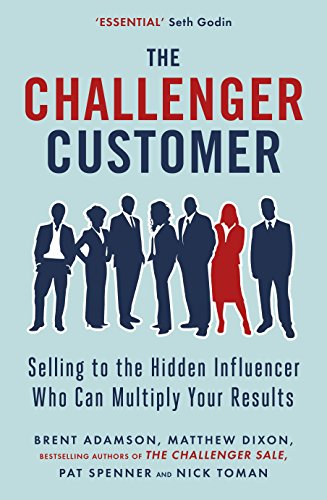
The Challenger Customer: Selling to the Hidden Influencer Who Can Multiply Your Results, by Nick Toman Pat Spenner

The Challenger Customer: Selling to the Hidden Influencer Who Can Multiply Your Results, by Nick Toman Pat Spenner


The Challenger Customer: Selling to the Hidden Influencer Who Can Multiply Your Results, by Nick Toman Pat Spenner

Ebook Free The Challenger Customer: Selling to the Hidden Influencer Who Can Multiply Your Results, by Nick Toman Pat Spenner

The Challenger Customer: Selling To The Hidden Influencer Who Can Multiply Your Results, By Nick Toman Pat Spenner How an easy idea by reading can boost you to be an effective individual? Reviewing The Challenger Customer: Selling To The Hidden Influencer Who Can Multiply Your Results, By Nick Toman Pat Spenner is an extremely basic activity. However, how can many individuals be so lazy to read? They will prefer to invest their spare time to chatting or hanging out. When actually, checking out The Challenger Customer: Selling To The Hidden Influencer Who Can Multiply Your Results, By Nick Toman Pat Spenner will certainly give you a lot more possibilities to be effective completed with the hard works.

To get rid of the issue, we now give you the innovation to purchase guide The Challenger Customer: Selling To The Hidden Influencer Who Can Multiply Your Results, By Nick Toman Pat Spenner not in a thick published data. Yeah, reading The Challenger Customer: Selling To The Hidden Influencer Who Can Multiply Your Results, By Nick Toman Pat Spenner by online or getting the soft-file only to check out could be among the methods to do. You may not really feel that reading a book The Challenger Customer: Selling To The Hidden Influencer Who Can Multiply Your Results, By Nick Toman Pat Spenner will certainly be beneficial for you. But, in some terms, May people successful are those that have reading practice, included this kind of this The Challenger Customer: Selling To The Hidden Influencer Who Can Multiply Your Results, By Nick Toman Pat Spenner

By soft data of the e-book The Challenger Customer: Selling To The Hidden Influencer Who Can Multiply Your Results, By Nick Toman Pat Spenner to check out, you may not have to bring the thick prints almost everywhere you go. Whenever you have ready to read The Challenger Customer: Selling To The Hidden Influencer Who Can Multiply Your Results, By Nick Toman Pat Spenner, you could open your gadget to review this e-book The Challenger Customer: Selling To The Hidden Influencer Who Can Multiply Your Results, By Nick Toman Pat Spenner in soft file system. So easy and quick! Reviewing the soft data e-book The Challenger Customer: Selling To The Hidden Influencer Who Can Multiply Your Results, By Nick Toman Pat Spenner will give you very easy means to check out. It can likewise be much faster because you could read your e-book The Challenger Customer: Selling To The Hidden Influencer Who Can Multiply Your Results, By Nick Toman Pat Spenner all over you really want. This on the internet The Challenger Customer: Selling To The Hidden Influencer Who Can Multiply Your Results, By Nick Toman Pat Spenner can be a referred book that you could take pleasure in the remedy of life.

Because publication The Challenger Customer: Selling To The Hidden Influencer Who Can Multiply Your Results, By Nick Toman Pat Spenner has wonderful benefits to check out, lots of people now increase to have reading routine. Supported by the developed technology, nowadays, it is uncomplicated to purchase guide The Challenger Customer: Selling To The Hidden Influencer Who Can Multiply Your Results, By Nick Toman Pat Spenner Also the publication is not alreadied existing yet in the market, you to look for in this website. As what you can find of this The Challenger Customer: Selling To The Hidden Influencer Who Can Multiply Your Results, By Nick Toman Pat Spenner It will really ease you to be the initial one reading this publication The Challenger Customer: Selling To The Hidden Influencer Who Can Multiply Your Results, By Nick Toman Pat Spenner as well as obtain the perks.

The Challenger Customer: Selling to the Hidden Influencer Who Can Multiply Your Results, by Nick Toman Pat Spenner

Four years ago, the bestselling authors of The Challenger Sale overturned decades of conventional wisdom with a bold new approach to sales. Now their latest research reveals something even more surprising: Being a Challenger seller isn’t enough. Your success or failure also depends on who you challenge.

Picture your ideal customer: friendly, eager to meet, ready to coach you through the sale and champion your products and services across the organization. It turns out that’s the last person you need.

Most marketing and sales teams go after low-hanging fruit: buyers who are eager and have clearly articulated needs. That’s simply human nature; it’s much easier to build a relationship with someone who always makes time for you, engages with your content, and listens attentively. But according to brand-new CEB research—based on data from thousands of B2B marketers, sellers, and buyers around the world—the highest-performing teams focus their time on potential customers who are far more skeptical, far less interested in meeting, and ultimately agnostic as to who wins the deal. How could this be?

The authors of The Challenger Customer reveal that high-performing B2B teams grasp something that their average-performing peers don’t: Now that big, complex deals increasingly require consensus among a wide range of players across the organization, the limiting factor is rarely the salesperson’s inability to get an individual stakeholder to agree to a solution. More often it’s that the stakeholders inside the company can’t even agree with one another about what the problem is.

It turns out only a very specific type of customer stakeholder has the credibility, persuasive skill, and will to effectively challenge his or her colleagues to pursue anything more ambitious than the status quo. These customers get deals to the finish line far more often than friendlier stakeholders who seem so receptive at first. In other words, Challenger sellers do best when they target Challenger customers.

The Challenger Customer unveils research-based tools that will help you distinguish the "Talkers" from the "Mobilizers" in any organization. It also provides a blueprint for finding them, engaging them with disruptive insight, and equipping them to effectively challenge their own organization.

  • Sales Rank: #132539 in Books
  • Published on: 2015
  • Original language: English
  • Dimensions: 9.21" h x .79" w x 6.02" l, .66 pounds
  • Binding: Paperback

Review
"I love it. This book will set the tone for years of work to come. The CEB team has just added the HOW to the WHAT that we have all been searching for since we launched into the Challenger journey. Helping your clients make buying decisions and then moving them to action, in your direction, is the HOW in this book that makes the biggest difference of all."
—MITCH LITTLE, vice president, worldwide sales and applications, Microchip Technology Inc.

"There is no sale more misunderstood (and expensively misunderstood) than the B2B sale. Here, in black and white, is an essential new way to think about it."
—SETH GODIN, author, Linchpin

"The Challenger Customer lays out a blueprint for how sales and marketing departments must rethink their approach to winning more business. What worked in the past is clearly having diminishing returns today, and will likely lead to failure in the future."
—JOHN GRAFF, vice president, corporate marketing, National Instruments

"The authors of The Challenger Customer have done high-quality and in-depth research that maps out the road ahead for marketers. The result is a handbook of practices that will help you get into your customers’ heads, deliver good value, and win the sale."
—DANIEL H. PINK, author of To Sell is Human and Drive

"This book provides evidence-based insights and practical guidance for solving one of today’s most pressing commercial challenges: complex decision making within customer organizations. It clearly shows what distinguishes the best sellers and marketing organizations from the rest."
—PINDER SAHOTA, general manager, Smith & Nephew

About the Author
BRENT ADAMSON, coauthor of The Challenger Sale, is a principal executive advisor in the sales and marketing practice at CEB.

MATTHEW DIXON, coauthor of The Challenger Sale and The Effortless Experience, is the group leader of the financial services and customer contact practices at CEB.

PAT SPENNER is the strategic initiatives leader in the sales and marketing practice at CEB.

NICK TOMAN, coauthor of The Effortless Experience, is the sales practice leader at CEB.

All four authors are frequent contributors to the Harvard Business Review and live in the Washington, D.C., metro area.

CEB is the leading member-based advisory company. By combining the best practices of thousands of member companies with its advanced research methodologies and human capital analytics, CEB equips senior leaders and their teams with insight and actionable solutions to transform operations.

Excerpt. � Reprinted by permission. All rights reserved.

PORTFOLIO / PENGUIN

An imprint of Penguin Random House LLC

375 Hudson Street

New York, New York 10014

penguin.com

Copyright � 2015 by CEB. All rights reserved.

Penguin supports copyright. Copyright fuels creativity, encourages diverse voices, promotes free speech, and creates a vibrant culture. Thank you for buying an authorized edition of this book and for complying with copyright laws by not reproducing, scanning, or distributing any part of it in any form without permission. You are supporting writers and allowing Penguin to continue to publish books for every reader.

ISBN 978-0-698-40618-6

To the members of CEB around the world, who challenge us every day to deliver insights worthy of their time and attention

FOREWORD

INTRODUCTION

THE HARDEST PART OF SELLING SOLUTIONS

CHAPTER 1

THE DARK SIDE OF CUSTOMER CONSENSUS

CHAPTER 2

THE MOBILIZER

CHAPTER 3

THE ART OF UNTEACHING

CHAPTER 4

BUILDING COMMERCIAL INSIGHT

CHAPTER 5

COMMERCIAL INSIGHT IN ACTION

CHAPTER 6

TEACHING MOBILIZERS WHERE THEY LEARN

CHAPTER 7

TWO TYPES OF TAILORING

CHAPTER 8

TAKING CONTROL OF CONSENSUS CREATION

CHAPTER 9

MAKING COLLECTIVE LEARNING HAPPEN

CHAPTER 10

SHIFTING TO A CHALLENGER COMMERCIAL MODEL: IMPLICATIONS AND IMPLEMENTATION LESSONS

ACKNOWLEDGMENTS

INDEX

FOREWORD

The odd combination of where I live and what I do for a living have turned me into a bit of a walking punch line over the past decade or so.

Let me explain.

I live in the Greater Washington, D.C., metropolitan area—the seat of the U.S. government—and I run one of the world’s most widely used sources of insight into corporate performance. So several hundred times a year in cities around the world, I introduce myself by saying “I’m here from Washington, D.C., to share some insights about best management practices.”

Business cultures differ widely across regions and nations, so the response to this statement runs the gamut from “You’ve got to be sh*&%ng me” (Silicon Valley, Amsterdam) to “I’m sorry, I think I misheard you” (Singapore, Minneapolis) to “Ah, you’ll feel at home here after a glass of wine. Try the Super Tuscan” (Rome). While the tone of responses varies, no one misses the irony at the heart of the statement. Like many national capitals, Washington has become a byword for organizational dysfunction. This is largely because citizens believe the U.S. Congress and similar deliberative legislative bodies that seem to take forever to act are useless, especially since when they do act they achieve only modest—if any—results.

All around the world, I routinely hear how much better off we’d be if only government would run itself like a business. The unfortunate truth is that—in many respects—it already does.

More specifically, business is increasingly running itself like a dysfunctional legislative body.

I THOUGHT THIS BOOK WAS ABOUT SALES AND MARKETING?

You’re now thinking that you’ve picked up the wrong book, but the headline of our recent work on sales, marketing, and the buying process suggests that in most B2B commercial environments purchasing looks a lot like a bickering Congress or Parliament on a bad day.

That’s why we’ve done a deep dive into the modern company’s buying process. As we started comparing notes across companies and industries, we realized that the stories commercial leaders were sharing were eerily similar to our own experiences—particularly when we were working with leaders to engineer dramatic innovations or step-function improvements in outcomes.

As the research team’s work continued, my own mind kept going back to a conversation I had with the controller of a German multinational who was using our work to radically simplify and accelerate information flow through his company. I visited on a day when the project’s kickoff (and ultimate ROI) had been delayed by three months due to a last-minute review requested by something called the “excellence assurance center of excellence” (that is not a typo).

The controller was in what could (charitably) be called a foul mood. The project itself was slated to last only six months, and he had enthusiastic support from the CEO and partnership from the CIO and head of HR. In terms of large-scale change management, he had really done everything right. And yet—at the eleventh hour, out of nowhere—a new stakeholder arrived on the scene, slowing down and lowering the aspiration of this fast-moving and ambitious effort. Leaning back in his chair, the CFO moaned, “I didn’t even know we had an excellence assurance COE.”

He got up, walked toward the window, and said, “This is a total [long German word that definitely didn’t mean “Really great day for our company: I just couldn’t be prouder to work here!”].

And it wasn’t a great day. Nor, by the end, was it a great project. By the time the COE review was complete, the project was rescoped twice, suffered three delays, and ultimately delivered a fourth of the original business value.

When I shared this story with an HR chief of a major conglomerate, she remarked, “That’s ridiculous.” I nodded, thinking she was going to share a story about how decisive she and her C-suite peers were relative to this poor controller’s company. She continued, laughing. “I once lost two months to our firm’s project-naming committee. He should be happy with that outcome.”

THE NEW REALITY FOR SALES: BIG, COMPLEX PROCESSES AND BIG, GERMAN CURSE WORDS

If it’s this difficult for a C-level executive to drive change through an organization, just imagine how hard it is for someone on the outside to galvanize support for a disruptive new solution. The data that we analyzed points to purchase processes characterized by an ever-expanding array of stakeholders with often competing agendas, changing purchase criteria, and—most troubling—a reversion to lowest-common-denominator behaviors.

Why?

We see this behavior as part of a broader trend in corporate operations. Several factors are reshaping how companies operate and make decisions, and all of them have implications for sales and marketing.

First, simply put, big companies are just bigger. The smallest Fortune 500 company is many times the size of the smallest one just twenty years ago. And with big size comes big complexity.

Information flows are multiplying quickly. While this means more educated buyers, it also means more people in the process—each with access to competing information and each empowered to form (and share) opinions. At its worst, information overflow can lead to complete decision paralysis—bad for companies and bad for the suppliers trying to engage with them.

Professional and control functions are strengthening within companies, with many having a say in virtually every decision. This is driven partly as a result of the need for scale and consistency across larger entities and partly because of concerns about risk and regulation. Obviously from a commercial perspective, the most important of these is procurement, but procurement is only one of the folks invited to the party—compliance, data privacy, IT security, EH&S, and quality often all weigh in on major buying decisions.

Emphasis on collaborative decision making is increasing in an attempt to reap the benefits of diverse perspectives on business issues.

None of these things are bad. In fact, all are undeniably good—bigger opportunities, more information, professional and analytic participants, and collaboration among different parties all ought to strengthen buying dynamics and make the process more likely to yield a successful purchase.

But all too often they don’t. Different functions bring different agendas to the table. Excessive collaboration adds time (but not value) to the process. Information abundance buries the core issues; opportunities that initially combined strategic advantage for the buyer with strategic opportunity for the seller get watered down or abandoned altogether. In the end, if any deal is reached, it’s for less scope and impact than what was initially proposed.

IF YOU CAN’T BEAT ’EM, MOBILIZE ’EM

By now, I’ve painted a pretty depressing picture of what lies ahead: slow processes, stalled deals, and customers unable to agree, settling for the lowest common denominator—or worse still, the status quo. But, thankfully, that’s not what’s in store. Beyond documenting and understanding the drivers of this tough new buying environment, we also found pioneering strategies for not only surviving, but also thriving in it.

Supported by an enormous amount of research, real-world sales experience, and practical lessons from leading sales and marketing teams, this book lays out a step-by-step path anyone can follow to dramatically improve commercial performance. It’s a path few are on today, but any company can pursue by carefully identifying and equipping a few select customer stakeholders to far more effectively mobilize the colleagues around them.

Whether you’re in sales, marketing, service, or support—from the front line to the corner office—each chapter of The Challenger Customer provides surprising findings for rewriting the rules for how the best companies connect with current customers, dramatically boosting sales performance as a result. All designed to drive decisive action among customer organizations increasingly predisposed to systematically avoid it. I hope you read it all the way through and consider its recommendations closely. Not only will your organization thank you, but your customers will too.

TOM MONAHAN

Chairman and Chief Executive Officer

CEB

INTRODUCTION

THE HARDEST PART OF SELLING SOLUTIONS

This is a book of surprises.

Chief among them is the surprising decline of historically effective selling strategies that now fail to generate anything near hoped-for returns.

Despite suppliers’ improved ability to convey their unique value, there’s strong evidence that today’s customers are less willing than ever before to actually pay for that value, even when they perceive it—at least not when they believe the next best, less expensive alternative is “good enough” to meet their needs. While today’s suppliers may win the battle for awareness, consideration, recommendation, and even preference, they still lose when it comes to what matters most: getting paid. As exasperating as it seems, the very solutions most companies developed to escape commoditization have themselves become commoditized in the eyes of their customers.

It all leaves commercial leaders wondering, “What do we do now? What’s left when the classic sales and marketing playbook we’ve relied on for so many years falls short?”

It was partly in response to these questions that CEB’s sales and marketing practice conducted the research that led to the publication of The Challenger Sale—an in-depth examination of the sales rep behaviors most likely to succeed in today’s commercial environment. But while the debate raged around us as to whether Challenger was right or wrong, new or old, too controversial or not controversial enough, we were focused on something else entirely: What else is there?

In fact, the more research we did, the more insights we uncovered and the more convinced we became that there was a second part to this story—one potentially more powerful than the first. It turns out, the far bigger story isn’t about suppliers’ struggle to sell solutions, it’s the customer’s struggle to buy them. While there are many reasons customers fail to buy, our data shows clearly that the primary culprit is the dramatic increase in both number and diversity of customer stakeholders typically involved in solutions purchases today—and, more damning, the severe dysfunction that is bred by the ever-expanding number of individuals who need to weigh in before a deal is signed.

In the end, what has long seemed to salespeople like a well-designed strategy to “stick it to suppliers” or beat them up on price is more often than not a function of a far less sinister but arguably infinitely more intractable problem: the inability of customer stakeholders themselves to achieve broad agreement on a common course of action in the first place. Much of the commoditization pressure suppliers face today isn’t the result of customers’ willingness to settle for “good enough,” it’s their failure to agree on anything more. And that’s a challenge most sales and marketing strategies fail to solve as it’s a problem they were never designed to address in the first place. In fact, current sales and marketing tactics exacerbate this problem rather than overcome it.

Of course, it’s hard enough to sell effectively. How exactly are we supposed to help our customers to buy more effectively? Here, the research holds a final, delightful surprise: just as we learned in our previous work that it is critical to have Challenger sellers, our latest work shows that it is equally (if not more) critical to have Challenger buyers.

In a series of quantitative studies, we were able to isolate and study these individuals. These aren’t your run-of-the-mill “coaches” or advocates doling out information to the sales rep and vocally championing a given supplier with colleagues. These are a special breed of customer stakeholder focused much more on marshaling the internal resources and buy-in necessary to compel their colleagues to collectively think and act beyond the status quo, irrespective of supplier. As we’ve studied these individuals in a great deal of depth, what we’ve found is: in a world of diverse and potentially dysfunctional customer stakeholders, it’s not just that you challenge, but who you challenge that really matters. To win today, you need a Challenger inside the customer organization.

These customer Challengers exist and can be found—but only if suppliers are looking for them in the first place. Because everything we’ve learned in all of our research clearly suggests that finding these individuals, winning them over, and then equipping them to win takes a completely different kind of commercial strategy than what’s worked so well in the past.

Who are these customer Challengers? We call them Mobilizers, and this is their story.

CHAPTER ONE

THE DARK SIDE OF CUSTOMER CONSENSUS

THE PROBLEM OF 1 OF 3

If there is one concern most top of mind among senior sales and marketing leaders around the world, it is the inexorable downward pressure on deal size, margins, and growth as they navigate continued uncertain times. While their CEOs mandate a “return to double-digit growth,” commercial leaders find themselves more frequently than ever before competing on little else but price.

Perhaps most frustrating, however, is that traditionally proven strategies designed to drive that growth no longer work nearly as well as they used to—leaving senior executives to assume they’ve somehow lost their way, broadly calling for a return “back to basics” as they exhort their teams to “recommit to more disciplined execution.” However, getting ever better at an approach already proven to fail does little more than demoralize everyone in the face of ever-deepening underperformance.

As the head of sales and marketing at a global industrial fragrances company recently put it, “I just don’t understand. We’re the leading supplier in our industry. Our products are world class, our brand second to none, and our salespeople are highly skilled. There’s not a single deal in our industry where we’re not invited to participate—we make it to the table every single time.”

“But even when we do,” he went on, “we’re always one of three suppliers at the table. Despite all of our commercial strength, we end up competing on nothing but price every single time. It’s killing our business. Our premium position simply can’t sustain that kind of margin erosion.”

It’s an incredibly common but still maddeningly frustrating scenario. Here’s a company that excels across every commercial metric that might matter but still faces deep commoditization nonetheless.

Welcome to what we’ve come to call the “1 of 3 Problem,” where a supplier commonly wins the battle for customer consideration—even preference—but ends up competing against two others on little but price nevertheless.

How to respond? Typically, heads of sales and marketing would tell you, “If customers fail to fully pay us for all the incremental value we provide, then clearly they must not appreciate all the incremental value we provide.” So they direct their teams to “sharpen” the company’s value proposition. They equip reps to “more crisply” articulate the many ways in which their company can not only meet customers’ needs, but exceed them. They carefully redesign marketing campaigns and sales collateral to better communicate the broad range of their company’s “best-in-class, cutting-edge solutions” and “unique ability to provide moments of deep customer delight.”

And yet in today’s world, even when delivered well, most customers’ reaction to suppliers’ costly efforts to better articulate their company’s value isn’t so much “Wow! We had no idea!” but rather something akin to “Yeah, we knew that already.”

Today’s customers will often concede the point right up front, responding, “We totally agree! We think you guys are great! Your solution is by far the best, and we’d love to partner with you!”

Which feels fantastic, until they add, “In fact, that’s why you’re one of the three companies we’ve invited to participate in this bidding process! But as much as we love your solution, this other company’s solution is good enough, and they’re a lot cheaper. So if we can get your solution at their price, then we’re good to go!”

And that’s painful.

Despite suppliers’ best efforts to better convey their unique value, there’s little evidence that today’s customers are any more willing to pay for that value even when they perceive it. At least not when they believe the next best alternative to be sufficiently “good enough.”

So a supplier wins in every way possible—raising awareness, consideration, preference, even recommendations—and still loses when it comes to what matters most: getting paid. This is the core dilemma of selling solutions today: most suppliers’ single biggest competitor isn’t so much the competition’s ability to sell as their own customer’s willingness to settle.

Across the last five years, the CEB team has dug into this challenge with a huge amount of research into both sales and marketing capability and customer buying behavior, seeking to understand what suppliers can do differently going forward to avoid the underperformance of past approaches. What we’ve learned is fascinating—if not more than a little bit troubling. Much of the problem lies less in a supplier organization’s inability to sell effectively and far more in a customer organization’s inability to buy effectively. And a very large part of that challenge lies squarely in customers’ struggle to achieve common agreement across the wide range of stakeholders now typically involved in virtually any solutions purchase.

THE RISE (AND FALL) OF THE 5.4

One might argue that the challenge of customer consensus is nothing new. Indeed, we’ve been hearing of the problem for years. And, of course, the economic downturn in 2009 did nothing but exacerbate the problem as increasingly cost-conscious and risk-averse decision makers balked at making even the smallest decisions on their own.

And yet, if we fast-forward to today, the strange thing is, while the global economy has significantly rebounded across virtually every metric that might matter, in that same time, the customer consensus challenge has become far worse. In a recent survey of senior sales leaders, we found nearly 80 percent reported the number of customer stakeholders involved in a typical deal continues to rise.

Why? There are all sorts of reasons for the added number of individuals involved in a deal today, but chief among them would be:

1. A sustained and widespread aversion to risk among both individual customer stakeholders and organizations in the aftermath of the global economic crisis

2. The fact that most “solutions” today have both a technological component and a higher price tag necessitating not only the involvement of IT but additional scrutiny by operations and procurements executives

3. A greater concern among legal and compliance officers that all corporate initiatives meet tighter regulatory requirements and information protection protocols

4. Governmental regulatory reform (especially in health care) forcing industry-wide shifts in how customers operate and buy

5. Customers’ efforts to expand operations globally, bringing new regional players to the table

6. The simple fact that most “solutions” offered by suppliers today are purposefully designed to integrate more customer functions and tasks than ever before in order to provide customers higher impact, better value, and improved ease of use

7. New management styles and organizational structures leading to flatter, more networked organizations that place a premium on more frequent cross-silo collaboration

Every one of these trends not only means more people involved in a typical purchase than ever before, but more important, more people across more roles who likely hadn’t been involved in the past. Of course, none of these trends is likely to reverse itself anytime soon. Bottom line, it’s nearly impossible today to get a deal done without accounting for a seemingly vast array of budget owners, influencers, end users, third-party consultants, you name it.

But as the consensus story continues to evolve, the thing we find most troubling isn’t the rise in number of people who have to “buy in” but the equally dramatic increase in number of people who have to “sign off.” So unlike the consensus challenge of 2006, which largely centered around winning over a single, senior decision maker and his or her team, today’s consensus challenge has evolved into something far more complex. Today, whether suppliers are selling to a customer with 50 or 50,000 people, they rarely find that almost mythical “senior decision maker” able to individually approve a complex deal on behalf of all of their colleagues.

Instead, more often than not, it’s purchase by committee. It’s collective consensus across a formal or informal group of senior employees, each with the ability to stop a deal if it fails to meet their particular needs, or speak to their individual priorities. And that problem, we find, stretches well beyond just larger customers or more strategic accounts. Consensus challenges are just as likely to crop up in small and medium customers where suppliers have traditionally been able to conduct most business through a single point of contact. As one sales leader in the food and beverage industry jokingly observed, “Even when we sell to mom-and-pops, we’ve got a mom and a pop, and they don’t always see eye to eye.” Small business isn’t exempt from the consensus challenge.

In fact, let’s put some real numbers against this problem. In a survey of over 3,000 stakeholders involved in a typical B2B purchase, we found that customers themselves report an average of 5.4 different people formally involved in a typical purchase decision. That’s 5.4 opportunities for someone to say “No.” And that one simple number raises all sorts of questions for suppliers. Things like: Do we even know who those 5.4 people are? For that matter, does our customer even know who those 5.4 people are? Sometimes they’re not sure either! What does each of these individuals care about? How does our solution meet their individual needs? How do we win them over?

The real trick in this new world of customer consensus is: this isn’t just 5.4 different people, it’s 5.4 different perspectives. Three-quarters of customer stakeholders we surveyed told us these 5.4 individuals span a wide variety of roles, teams, functions, and geographies. And really, this is the true challenge of consensus today. It’s not so much that there are more people in a sale that makes things so hard, but that there are so many new perspectives.

Every supplier has a version of this exact same story. For example, if you sell an IT solution, almost certainly you’ve traditionally called on the customer’s CIO and his or her team. But as most IT solutions today touch other parts of the business (or more business decisions than ever before now feature a strong technological component), now you’re just as likely to also sell to CMOs, COOs, or heads of HR—depending on who’s using your system. Additionally, the broader scope and bigger footprint of your solution probably means you’re also speaking with the CFO, to procurement, and maybe to regional presidents. Not to mention a whole range of end users, influencers, third-party consultants, and even potential partners. And lest we forget, legal (aka the “Sales Prevention Department”). Indeed, one head of marketing in the health care industry recently told us, “For us it’s not 5.4 people, but 5.4 committees of people!”

Bottom line, every supplier has their version of the same story, regardless of industry. We used to sell to X, and now we sell to X, Y, Z�.�.�. as well as A, B, and sometimes C. And every one of them is different. Different priorities, different perspectives, different authority, even different levels of knowledge of what the supplier’s solution actually does in the first place, and why that matters.

That’s the real challenge of customer consensus today. It isn’t just a quantity problem. It’s a diversity problem. Because when these groups come together to make a decision, almost inevitably, it seems, things fall apart.

Take a look at figure 1.1.

FIG. 1.1. Purchase Intent, by Buying Team Size

In a survey of 3,000 customer stakeholders involved in a B2B purchase, we asked respondents the degree to which they agreed with the statement “We will definitely buy from this supplier in the next six months” on a scale from 1 to 10 (we tested other time horizons and got virtually the exact same result. Six months allowed us to capture the largest sample). We then mapped those responses according to total number of people on the buying team.

Now, the path of that line in figure 1.1 tells a dramatic story, featuring two distinct downward inflection points. The first represents a rapid drop in purchase likelihood just by adding one more person to the purchase decision. So going from one to two people means overall likelihood to buy goes off a cliff, dropping from 80 percent to the mid-50s (indeed, apparently mom and pop don’t always agree). Then things level out for a bit until we get past person number five. Then there’s a second cliff where likelihood to buy sinks like a stone to a dismal 30 percent. As a supplier selling to the 5.4, this is a hard graph to look at. From left to right, this is a one-way ticket to indecision with a final stop somewhere squarely in the center of what some sales leaders have come to call the “solutions graveyard.”

From a research perspective, this finding proved hugely important as it gave us the first indication in all our data that suppliers don’t have nearly so much of a selling problem as perhaps they do a buying problem—brought on largely by the new and wildly diverse cast of characters typically involved today in any solutions purchase.

For suppliers, however, that’s a tough finding to digest, as it’s hard to know how to manage this kind of challenge. After all, customer diversity isn’t something suppliers can make go away by telling their customer, “Actually, we don’t think your legal or procurement teams need to look this one over.” For even if that attempt were to succeed in the short run, the long-term consequences can be costly. As the chief sales officer at a global manufacturing company recently told us, “We actually tried exactly that just last year. And it worked! We successfully cut everyone out of the purchase other than the head of operations and got the deal done in record time!

“The problem,” he went on, “was that when we then went to implement what we’d sold, all those people we’d previously cut out realized what was happening and completely overwhelmed the installation with objections and conflicts that we could have handled in advance if we’d just included them to begin with.

“In the end,” he said, “as hard as it may have been, we would have been far better off getting all those individuals on board as part of the purchase process because the bad will we generated as part of a rocky implementation not only undermined this deal, but likely cut us out of future deals for the foreseeable future.” It’s an incredibly tough thing to find out after it’s too late to do anything about it.

But it raises the questions: If suppliers can’t fully (or even partially) eliminate customer diversity as part of a sale, then how can they at least manage it more effectively? What’s the best strategy for selling to increasingly diverse customer buying groups?

TRACK THEM ALL DOWN AND WIN THEM ALL OVER

Around the world, the strategy for selling to diverse stakeholders follows the same, frustrating reality. It requires a whole lot of work, and it requires a whole lot of time. In fact, most sales professionals agree, the battle for customer consensus plays out across two dimensions, not just one.

FIG. 1.2. Common Consensus-Building Strategy

The first dimension is a challenge of access—simply winning the right to get in front of all the individuals who matter in the first place. And that’s hard. With all those new people involved, the first step is figuring out who they all are in the first place. We encourage sellers to begin with the question “Who are our 5.4 for this particular deal?” It’s a disarmingly simple question, but often surprisingly difficult to answer. In many cases, these aren’t just new individuals, but new roles, functions, and maybe even geographies that that supplier has traditionally never called on before. And chances are pretty good that customer stakeholders’ exact role in the purchase may be somewhat murky even to themselves.

Beyond identifying them, however, is the more difficult task of winning the right to speak with them, particularly as a seller may have little to no prior experience or existing connections to fall back on—even in existing accounts with otherwise long-standing relationships. What’s worse, from the perspective of that target stakeholder, they may see no especially pressing need to talk to that supplier at all if they fail to see a relationship between their immediate concerns and the supplier’s capabilities.

Beyond winning access to each of these individuals, however, sellers still face the even greater challenge of winning each of them over, ensuring they position their offering as precisely as possible, so as to resonate with each stakeholder’s priorities and needs. And they have to do that 5.4 times—tracking them all down and then winning them all over.

Now, one might argue there’s nothing new here. After all, that’s nothing more than just plain good selling, same as it’s been for years. But the real challenge is, this is no longer a single sale, but a serial sale, each one a little different and carefully positioned to each stakeholder. To be sure, it is great selling. But it’s great selling times 5.4! Checking off each stakeholder as they go, ensuring they’ve bought in before they move on to the next one.

This one challenge has become the heart and soul of most sales managers’ check-in calls with their team: “So who have you called on so far? How did it go? Are they on board? How do you know? OK, who’s next? How are you going to get in front of them? How are you going to position things for them? How do you think they’ll react? What objections do you think they might have [insert role play]? OK, who’s left after that?”

So reps work from the known to the less known, the familiar to the less familiar, slowly building consensus step-by-step as they seek to collect a “Yes” from each of those conversations.

A tenured sales manager we interviewed memorably compared it to the plate-spinning act at the circus. You get the first plate spinning on the stick and then move on to the second. You get the second one spinning and move to the third. But somewhere along the line, the first plate has started to wobble, so you have to go back and get it under control as you’re simultaneously trying to move on to the fourth. And so it goes across the board, winning one stakeholder at a time. “Check!” “Check!” “.�.�. aaaaannnnnd check!”

But the deeper into the 5.4 we go, the harder these conversations become. In an all-too-common (but still deeply painful) scenario, the head of sales at a company that sells highly technical instruments for the manufacturing sector told us that his sales reps are almost exclusively trained engineers—which has always made sense in the past as they’ve traditionally called on engineers inside the customer organization. However, across the last five years, as the scope, impact, and expense of their newer solutions have expanded, they can now rarely get a deal done without also speaking with the customer’s head of finance. The problem is, their reps have never sold to CFOs before and find them completely intimidating, so they avoid calling them altogether! But what do you do when your own sales force is literally too scared to call your customer? At first glance it might sound somewhat absurd, but this happens all over the world, every single day. This is what happens when sellers move into the world of the 5.4. Sales reps’ familiar comfort zone of selling doesn’t expand nearly as fast as customers’ required consensus zone for buying.

Likewise, parallel efforts in marketing don’t fare much better. A recent move in B2B marketing toward something known as B2P—or “business-to-people”—marketing arises in part from this exact same trend. There, the thinking goes, even in the world of business-to-business buying, it’s not companies that buy things, but people that do. And with the rapid increase in both number and diversity of people involved in a typical purchase, suppliers have to understand those people today far better and get in front of them far earlier than ever before with content and campaigns that will more specifically speak to each of their unique needs and priorities. In many ways, it’s the marketing analog to the “track them all down and win them all over” sales strategy.

So not surprisingly, then, we’ve observed a strong and renewed interest among more advanced marketing teams in building ever more accurate customer personas, trying to understand individual buyers and their needs. Simultaneously, we’ve watched marketing organizations dedicate increasing amounts of time and money to building more targeted content, designed to speak to very specific members of the 5.4 about the issues they care about most at each stage of the purchase journey.

Given the scope of the challenge, however, these same teams (often made up of only a handful of people) become easily overwhelmed trying to place highly personalized, original content in all the right places, at all the right times, for all the right people involved in a typical purchase process. Even then, there’s often little concrete evidence to show that any of this effort translates into real commercial outcomes, leaving marketers to point to intermediate measures like increased click-through rates or more “likes” on the company Facebook page to justify the added time and expense of their effort.

When we put it together it’s no wonder that commercial leaders around the world complain of increased cost of sale, longer cycle times, stalled deals, and smaller deal sizes. The ongoing battle of tracking down each of the 5.4 and then successfully winning each of them over not only takes a huge amount of time and effort, it’s fraught with challenge every step of the way. And it leaves commercial leaders around the world thinking the same thing. As one head of sales and marketing put it to us rather poignantly, “There’s got to be a better way. All this customer consensus is killing our business!”

But what could that better answer be?

IN SEARCH OF ANSWERS

Given this strong pressure on performance, the CEB sales and marketing practice recently set out to study the dynamics of customer consensus in far greater depth than we ever had in the past.

At the center of this work was an effort to supplement the vast amount of customer research we’d already conducted in the past with new data, aimed at group buying dynamics. And much of that data came from a survey of 1,000 people all involved in some fashion in a typical B2B purchase, representing a wide range of both industries and geographies. More than anything else, the survey was designed to shed new light on the complex relationship across group buying behaviors, commercial outcomes, purchase attributes, and sales rep behavior.

The story that arose from all that work is fascinating as, upon first glance, it is deeply counterintuitive. In fact, when we first ran our analysis, we weren’t sure whether we should believe the result. We went back and reran the numbers, remodeled the data, rechecked the sample in an effort to undo a finding that we initially found very difficult to believe. But the findings proved incredibly robust. Though those findings didn’t seem to make a lot of sense when we first saw them, as we dug deeper into the data (and continued to dissect the challenge it was meant to address), we came to the conclusion that we’d been thinking about the consensus problem in exactly the wrong way. The implications for sales and marketing were huge.

AN UNEXPECTED FINDING

To show you what we mean, let’s start with a concept we’ll call a “high-quality sale”—which serves as the backbone for much of our consensus work.

The idea here is: Suppliers aren’t looking to close just any business. They’re looking to close good business. So while it is true that suppliers lose to status quo far more often than they’d like, it is equally true that even when they win, they often don’t win the way they’d hoped. Perhaps the customer bought a much smaller “good enough” version of their solution. Or maybe the customer so completely beat them up on price that the deal came in way below target margins. So technically, we might call those deals “wins,” but they’re hollow victories at best. We hear this all the time from commercial leaders. It’s not so much the low quantity of deals they’re doing that causes the real pain, but the low quality of the deals that are ultimately sold.

So when we talk about a “high-quality sale” in our data, what we’re trying to capture is the kind of deal where customers buy the bigger solution at a higher margin. In our study, we defined a quality sale as a deal where customers:

1. Did not settle for a less ambitious solution, but

2. Purchased a premium offering relative to the base offering

We tested for those attributes through a number of different questions across our various survey instruments.

So now the question becomes, how do suppliers win that kind of high-quality deal—especially in a 5.4 world?

Well, let’s go back to our strategy for selling to diversity in the first place and see what happens. You’ll remember, the conventional sales and marketing approach in the 5.4 world is, we have to track them all down and then win them all over. When we ran the various commercial activities associated with that approach through our model, we found something rather shocking (see figure 1.3).

FIG. 1.3. Comparison of Drivers on Likelihood of Supplier Winning a High-Quality Deal

When we measured each of those two approaches (i.e., winning access, or “tracking them all down,” and then better individual positioning, or “winning them all over”) against the probability of winning a high-quality sale, we found that winning access to key stakeholders boosts that probability by a positive 4 percent, but positioning our offering to resonate more strongly with each stakeholder actually reduces that probability by 4 percent.

Now, what do those numbers mean? Let’s take them one at a time. The way to interpret the access number, for example, is this: if we were to move from below-average performance to above-average performance on winning access to each stakeholder across the 5.4, we’d be 4 percent more likely to close a high-quality deal.

In other words, access matters. It has a statistically significant impact on driving up deal quality. Though, you’d likely agree, it doesn’t appear to matter nearly as much as anyone might have thought. After all, a 4 percent increase doesn’t seem to be all that meaningful. That’s kind of strange.

But even stranger is our finding for tactic number two. This is about winning over each stakeholder, one at a time, by connecting our offer as strongly as possible to whatever they care about the most. So we position our offer to meet their needs, emphasizing our ability to address their specific priorities, speak to their individual view of what’s important, and connect directly to what they’ve got to get done (i.e., their MBOs, personal projects, etc.). And the impact here is actually negative.

Now what does that mean?

Well, what it means is that the better we get at customizing our offer at the individual level, the less likely we are to close a high-quality deal. Effectively personalizing our offer to each stakeholder decreases deal quality, pushing us deeper into the very commodity trap we were hoping to avoid by personalizing in the first place.

In fact, when we dig into the data one level deeper, we find that if we move from below-average performance to above-average performance on personalization, we’re 20 percent more likely to have a negative impact on overall deal quality. In other words, the better one positions the offer to the individual, the more likely there is to be a negative impact on overall deal quality. It doesn’t seem to make any sense.

Most helpful customer reviews

3 of 3 people found the following review helpful.
Discover why so many B2B sales never happen!
By Douglas N. Burdett
[[VIDEOID:d42b49790ee460e8945a1956f0903787]] Hi I’m Douglas Burdett, host of The Marketing Book Podcast and I’d like to tell you about the book “The Challenger Customer: Selling to the Hidden Influencer Who Can Multiply Your Results” by Brent Adamson, Matthew Dixon, Pat Spenner and Nick Toman.

OK, first off - if you’re familiar with the bestselling book “The Challenger Sale,” “The Challenger Customer” is from the same authors at CEB.

You may know CEB as the organization that determined in B2B sales, the customer is at least 57% through their buyer’s journey before they first reach out to the seller.

Like The Challenger Sale, The Challenger Customer takes on and refutes a lot of conventional wisdom about what works and what doesn’t work in modern B2B marketing and sales. But here’s the catch - it’s not just the author's’ opinions. They challenge the conventional wisdom with extensive research done over the last five years.

It turns out only a very specific type of customer stakeholder has the credibility, persuasive skill, and will to effectively challenge their colleagues to pursue anything more ambitious than the status quo. These Challenger customers get deals to the finish line far more often than friendlier stakeholders who seem so receptive at first. In other words, Challenger sellers do best when they target Challenger customers.

I work in the field of B2B marketing and sales, and the conclusions in this book had me thinking (and rethinking) all the best practices in that field.

In one sense, I wish I hadn’t read the book. But I’m glad I did.

And, to listen to an interview with Pat Spenner about “The Challenger Customer,” visit MarketingBookPodcast.com.

0 of 0 people found the following review helpful.
Nailed it.
By Caleb Hanson
I work in software (in a role that supports sales), and we have a pretty complex value-based sale, selling into large enterprises. I'm not a sales guy, but I need to think like one and support our sales machine, and this book is invaluable. The first half is required reading for product people, marketing people, anyone involved in supporting the sales people. The second half is really geared to the sales part of the org and I skimmed it, but the first half of this book alone made it worth the price.

13 of 15 people found the following review helpful.
#1 Challenge buyers by showing them their status quo is not good enough and is cutting into profit
By Jeremey Donovan
The gist of the book is as follows:
#1 Challenge buyers by showing them their status quo is not good enough and is cutting into profit, wasting effort, and/or increasing risk.
#2 Partner with and enable "Mobilizers" inside the buying organization to drive consensus around the problem, the solution, and vendor selection.

Like The Challenger Seller, I gave this book 5 stars for the quality of the overall insights. Of the two books, this one is better (and is inclusive of the content in its predecessor). Also, like The Challenger Seller, this one suffers from a LOT of redundancy and out of order content - a natural consequence of having too many authors without painstakingly meticulous editing. Unlike The Challenger Seller, the Challenger Customer does a much better job of justifying conclusions & recommendations by providing references to studies with decent sample sizes.

Here is a more detailed summary:
Closing a complex deal requires collective consensus from, on average, 5.4 decision makers as they march through the three main stages of the buying cycle: (1) problem definition (2) supplier-independent solution identification (3) supplier selection.

“On average, customers are 57 percent of the way through a typical purchase process prior to proactively reaching out to a supplier’s sales rep for their direct input on whatever it is that they’re doing.”

Successful reps:
a. Challenge customers’ beliefs with a new and compelling insight to make money, save time, or lower risk. This insight must provide a compelling reason to take action now by explicitly laying out why the customer’s current behavior is not “good enough” and is costing them time or money in ways they never realized.
b. Leverage (online) diagnostics and pain (not ROI) calculators
c. Partner with buyer stakeholders, called “Mobilizers,” who are able to (i) drive change and (ii) build consensus. Mobilizers can be identified because they do all of the following: (i) ask challenging, thought providing questions rather than just listening & agreeing, (ii) focus on the greater good of the organization rather than their personal goals, and (iii) agree to take on research or tasks
d. Enable Mobilizers by providing THEM with sales tools, workshops, proof points, stories, etc.
e. Find the strategic overlap between the each stakeholder’s goals and then facilitate/build convergence to get to a collective yes around a single, overarching business goal/vision.
f. Identify and convert Blockers, especially by leveraging supportive buyer stakeholders
g. Align the stages of the buying process with verifiers / buying signals. These are expected actions the customer must take. Examples include: commits to analysis, commits to seller demo, & states we are the preferred vendor.

See all 55 customer reviews...

The Challenger Customer: Selling to the Hidden Influencer Who Can Multiply Your Results, by Nick Toman Pat Spenner PDF
The Challenger Customer: Selling to the Hidden Influencer Who Can Multiply Your Results, by Nick Toman Pat Spenner EPub
The Challenger Customer: Selling to the Hidden Influencer Who Can Multiply Your Results, by Nick Toman Pat Spenner Doc
The Challenger Customer: Selling to the Hidden Influencer Who Can Multiply Your Results, by Nick Toman Pat Spenner iBooks
The Challenger Customer: Selling to the Hidden Influencer Who Can Multiply Your Results, by Nick Toman Pat Spenner rtf
The Challenger Customer: Selling to the Hidden Influencer Who Can Multiply Your Results, by Nick Toman Pat Spenner Mobipocket
The Challenger Customer: Selling to the Hidden Influencer Who Can Multiply Your Results, by Nick Toman Pat Spenner Kindle

The Challenger Customer: Selling to the Hidden Influencer Who Can Multiply Your Results, by Nick Toman Pat Spenner PDF

The Challenger Customer: Selling to the Hidden Influencer Who Can Multiply Your Results, by Nick Toman Pat Spenner PDF

The Challenger Customer: Selling to the Hidden Influencer Who Can Multiply Your Results, by Nick Toman Pat Spenner PDF